
The Work of Being Happy
What Ancient Philosophers Taught Me While Writing The Happiness Collector

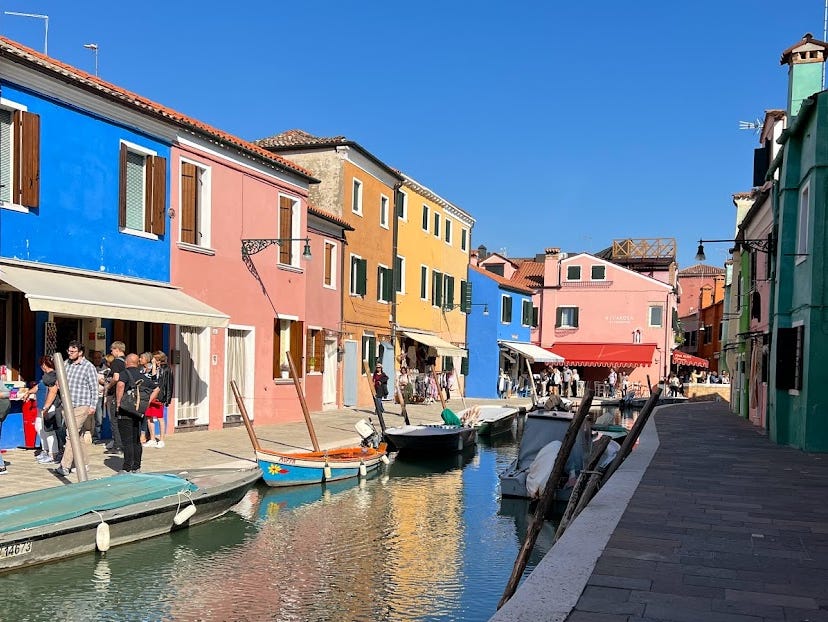
I’m getting ready to launch a book about happiness disappearing from the world. As part of the writing process, I’ve done an awful lot of thinking about what happiness is and what it means.
These days, we often talk about happiness as something to optimize. There are apps that track it (I personally love Daylio), journals that promise to strengthen it, and podcasts (I highly recommend this one by happiness researcher Laura Santos) that tell us how to feel better. We are obsessed with finding happiness and figuring out how to keep it.
While I was writing The Happiness Collector, I kept coming back to one question. What if the problem isn’t that happiness is elusive? What if it is being drained from us, quietly and constantly? I began the book in the long blur of the pandemic, and I’m launching it in a time where so many distressing things are happening that feel designed to keep people anxious or numb. I wanted to understand what happiness truly is when the world feels so determined to erode it.
Ancient philosophers wrestled with this, too, though they asked different questions than we do now. They weren’t searching for emotional balance or a better morning routine. They were asking what it means to live well, even under the weight of war, disease, and political collapse. Over and over, I find myself turning to the Stoics, who, two thousand years ago, had also done a lot of thinking about happiness and the meaning of life.
Epicurus is often misunderstood as a champion of indulgence. He has been reduced to a shorthand for excess: feasting, drinking, giving in to every desire. But his idea of happiness was far more restrained. He believed that real contentment came from the absence of pain, both physical and mental. That state was called ataraxia. To reach it, he advised people to live simply, surround themselves with trusted friends, and free themselves from unnecessary desires and irrational fears. In his view, unnecessary pleasure—especially the kind that causes anxiety or dependency—was a trap. A calm life, guided by reason and supported by community, was the key. For those curious to explore his thinking, The Art of Happiness, translated by George Strodach, is clear, brief, and full of surprisingly modern insights.
The Stoics believed that happiness was found not in peace, but in discipline. For them, the central challenge of life was not to avoid suffering but to face it with strength and integrity. Seneca, Epictetus, and Marcus Aurelius all argued that the path to a good life required separating what we can control from what we cannot. Emotions were not something to be avoided, but something to be examined. By practicing detachment from outcomes and holding ourselves to a high moral standard, we could find freedom even in brutal or unjust conditions. Marcus Aurelius, writing as emperor during a time of war and plague, filled his journal with reminders not to be ruled by fear, anger, or desire. His Meditations remains one of the most intimate and enduring works of self-reflection. For a modern entry point, Donald Robertson’s How to Think Like a Roman Emperor draws smart parallels between Stoicism and therapy, without simplifying the philosophy.
Aristotle approached happiness with a wider lens. For him, happiness—eudaimonia—was not about feeling good, and it wasn’t about avoiding pain either. It was about flourishing over a lifetime. To be happy, in Aristotle’s sense, meant living in alignment with your nature, guided by reason and virtue. He believed that happiness required more than good character. It also depended on friendship, participation in civic life, the development of intellectual and moral excellence, and the chance to act on your potential. It wasn’t something that could be measured in a moment. You could only be said to have lived happily once your life had shown its full shape. He wasn’t interested in mood. He was interested in legacy. If you want a contemporary guide to his philosophy that doesn’t oversimplify it, Edith Hall’s Aristotle’s Way is a rich and readable resource.
What unites these ancient perspectives is the belief that happiness is not something that happens to you; it is something you build. Not quickly, not always easily, and not necessarily with pleasure. That idea still holds value. But it doesn’t account for everything.

The ancient philosophers believed that happiness, however difficult, was still largely within our control. They could not have imagined a world where fear is used to drive clicks, where despair is profitable, where people are rewarded for cruelty, and others are punished for being hopeful. They did not live in a world built to make people feel powerless.
That is the premise of The Happiness Collector. Not the familiar question of how to be happy, but whether happiness can endure in a world that benefits from its erosion.
I don’t know the answer. But maybe the asking matters more than the answer ever did. Epicurus, Marcus Aurelius, Aristotle—they were all trying to figure out how to live with meaning when the world refused to make it easy. So are we, over 2,000 years later.
What makes YOU happy? Let me know in the comments!
Come chat with me about The Happiness Collector!
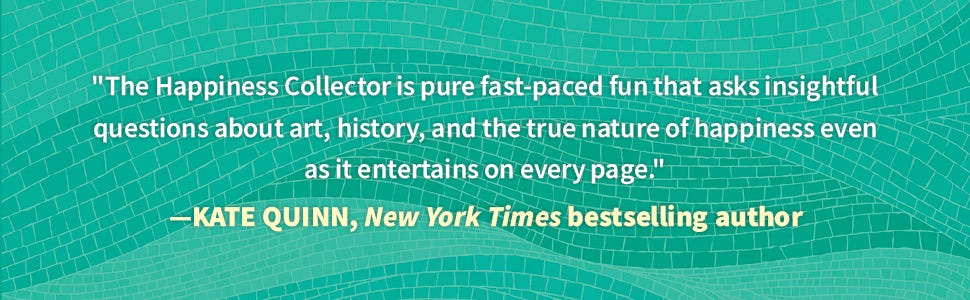
I’ll be at a number of events in the coming months, starting with these fantastic venues. I would make me extraordinarily happy to see you there!
Lovestruck Books, Cambridge, MA, December 2, 7PM in conversation with Julie Carrick Dalton. There will be cake!
Newtonville Books, Newton, MA December 3, 7PM in conversation with Greer McAllister.
Rozzie Bound Co-Op December 6, 1-2:30 PM Book Signing
Book Ends, Winchester, MA January 15, 7PM in conversation with Marjan Kamali.
What’s Bringing Me Joy
Talking Heads’ Once in a Lifetime, as you have never seen it.
Reddit has a bunch of games now, and this simple syllable guessing game is fun.
This funny little Italian puppet-animated film from 1937.

I’m wishing my US friends a happy and safe Thanksgiving! I’m SO grateful for all of my readers…of this Substack and my novels. I am so lucky to have my words matter to you all. 🙏🦃🥰🩷 Now, onward to my favorite season!!

If you love food and love Italy, and haven’t read IN THE GARDEN OF MONSTERS, THE CHEF’S SECRET or FEAST OF SORROW, click the links to learn where to buy your copy! And now you can pre-order my latest, THE HAPPINESS COLLECTOR out on December 2!
Follow me here: Website | Instagram | Facebook | Threads | Bluesky | TikTok
You raise a lot of intriguing questions. And I love the citations of the ancient philosophers -- a lot of food for thought! "The Happiness Collector" sounds like a myth for our time. I do feel that our happiness is being drained from us, surreptitiously and constantly. It is a deliberate tactic to distract and disempower us. Although I've read all your other books, I wasn't thinking about reading this one until reading this post. It's now at the top of my TBR-Don't Miss List!
That photo of Burano really struck me-- a relatively simple place, but with the bright colors, the symmetry and proportion of the architecture, and the water, it looks like a place specifically designed to make people happy. Which made me think-- if we have the capability to build things in a way that is naturally pleasing, why do we instead so often build things that are ugly, or utilitarian, or dehumanizing? And when we persist in doing it, why are we subsequently surprised that our cities are filled with unhappy, angry people?