

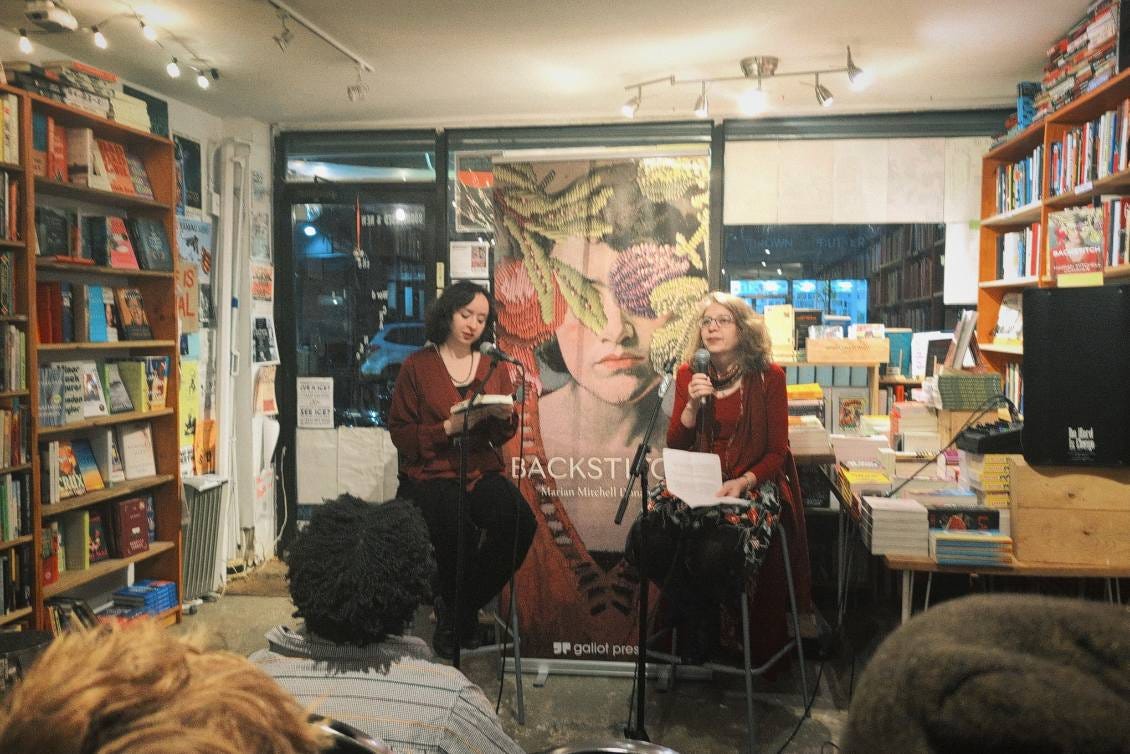
Several years ago, my writing colleagues (and fellow authors), Anjali Mitter Duva, and Henriette Lazaridis, mentioned they were thinking of starting a press. And they did! What was born from that was Galiot Press. “We started Galiot Press because we saw that publishing was full of problems—for writers and for readers hungry for something different. We had one vital principle in our approach: not to simply replicate flawed practices that presses were already using. We looked outside publishing, to other industries, for innovations and systems to make book publishing—and book buying and reading—better. Better for the writer, the reader, and the environment.”
They have four books under their belt now, including the latest, Backstitch, by Marian Mitchell Donahue, which has such an arresting, gorgeous cover. Of course, I wanted to know all about it, so let’s dive in. And stay tuned to the end of the newsletter for your chance to win a copy!
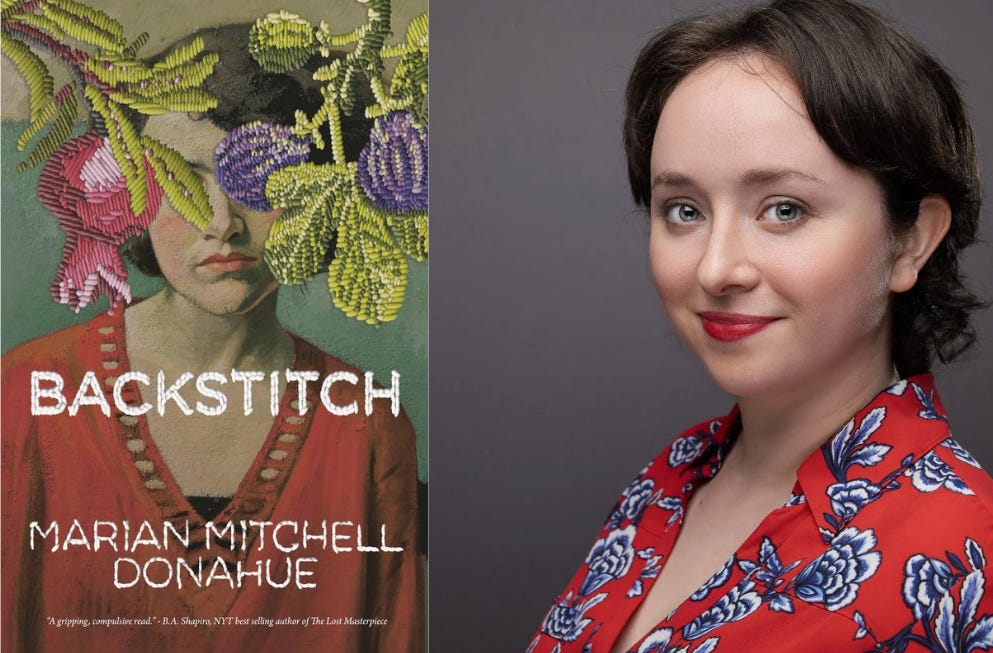
Set in an art gallery in the Washington, DC area, and structured as a journey through the gallery’s rooms, Backstitch is the story of two sisters who reunite at a retrospective of their troubled mother’s art and must confront the consequences of her ambition and the difficult, private truths behind the family’s public narrative. The novel is an exploration of family ties, the gift and cost of artistic talent, and the legacy that the artist’s daughters must carry.
On your website, you say your work “explores connection, transformation, and the quiet moments that shape who we become.” And also, you were raised in a family of artists. Tell us about the genesis of this story, and how it relates to your background and this exploration of yours.
I started writing the first draft of this story back in 2017, but I had wanted to write a story about artists for years before then. Art and family have served as two major influences in my life from a young age. My parents were both theatre teachers, now retired, my sisters are both visual artists, and my grandfather was a painter. I grew up surrounded by the artistic process, witnessing the behind-the-scenes moments of people actually doing the work to create a piece of art and I wanted to capture that intimate, difficult work on the page. I was also very interested in how people craft their identities, both as artists and as private people. What parts are an act and what parts are true? How blurry is the line between the two? I knew I wanted to capture what an artistic process looks like from a child’s perspective, because that’s how I first experienced it, so that naturally led me to write about daughters watching their mother create art.
How you handle the passage of time in this book is complex and ambitious, and you pull it off really well. It weaves back and forth through time—like a backstitch!—and through points of view: Violet and Marigold as children and as grown women, Alice before motherhood, Alice as a mother, Alice as an artist (which really she is all the time), Alice in relation to the various men who loom large or less large at various stages of her life. Tell us about how this structure came to be, and what you wanted to achieve through it. Was this your planned structure from the start?
There are some elements of this book’s structure, like a museum form, that have been there from the beginning, and some that developed along the way. The very first draft of this book was told entirely from Violet’s perspective, and it was more chronological, but the more I wrote, the more freedom I needed to really capture where I felt the heart of the book lay, so I started experimenting with perspective and time. I knew from the start I wanted each chapter to represent a piece of art, and that each chapter would have a corresponding museum wall placard, so that the reader would be looped through the museum exhibit at the start of each chapter. The more I wrote, though, the more loops I found for the structure of the book to follow. I could loop backward and forward in time. I could double up scenes, telling it first from one perspective and then later through another. The more I explored the form of a backstitch, the more ways I found to use it in the novel. A way to move forward by going backward.
Speaking of structure, the book starts with a map of an art gallery, and each chapter begins with what looks like the placard that would be on the wall of a gallery next to a piece of art. Could you tell me a bit how this aspect of the structure serves the story, and also how you managed to be so inside the characters while also writing up the placards the way a curator would, from the outside. Because to me, part of what makes this book incredible is how well it contrasts the public perception of art and its creator against the private truths of the person and the creative process.
The museum is the organizing structure of the book but it’s also an expression of a daughter’s attempt to reclaim the narrative of her life. In the book, the exhibit is curated by Marigold, Alice’s younger daughter. So while I tried to capture the authority you often hear in museum placards, I also wanted to hint at the not-so-invisible hand of the curator through these elements. It’s another loop for the story to follow, from the reader, through Marigold’s curatorial decision-making, through the art, through the past, and then back to the reader again. The placards, though short, took a lot of time to get right because they needed to capture some essence of the work that followed it but still maintain a distance from the messy insides. This was another chance for me to have a character make decisions about how her story is told to the public.
Let’s talk about Alice here. What a complex, heartbreaking, inspiring, strong yet vulnerable woman she is. Throughout the book I wanted to hug and protect her and also I was so angry at her. There isn’t a page on which she appears that doesn’t elicit a strong reaction in the reader. Tell me a bit more about Alice and what she is, or what she represents, to you.
Alice is the center of the book in a lot of ways. When I thought about the book through its astronomical lens, I often thought about Alice as the Sun and all the other characters orbiting her, on their own paths but constantly oriented toward her. My original idea with Alice was to create a mother/artist character that had the hallmarks of different father/artist characters I had come across. Someone who could be charming, distant, wounded, strong, selfish, loving, passionate about a singular focus, and disengaged from everyday life all at once. I wanted to take all of this and further complicate it with the ideas of what a wife and mother “should be,” how women are expected to act and are usually set up to fail in this mix of impossible circumstances.
This book has so many exquisite, visceral passages that depict the artistic process and works of art—photography, embroidery, painting, and more. It is a feast for the senses. Transferring one form of art into words on a page is itself an artform. And it’s one you teach—ekphrastic writing. Could you talk about how you came to hone this skill, and a bit about how you teach it?
I love ekphrastic writing. As a reader, it’s one my personal favorites and as a writer I find it encourages me to push my creative boundaries. The core of ekphrastic writing, to me, is observation. It’s training yourself to see things better. When I teach ekphrastic writing, especially inspired by famous works of art like Gustave Klimt’s The Kiss, I often hear surprise at how students suddenly discover new elements of the original work through ekphrastic writing. “I never noticed they were so close to the cliff’s edge/I never thought how uncomfortable she must be in that position.” Ekphrastic writing challenges what we think we see and what we think we already know. It invites us to examine what we bring to art, making the act of experiencing art an exchange between viewer and piece instead of a one-way street.
As Cara Blue Adams writes in her review of Backstitch in the NY Times, there’s a history of women—it’s usually women—using their children in their art. Some people would say abusing. Sally Mann’s photos of her children, for example, stirred up a major controversy. In our times, this type of controversy has spilled onto the internet—mommy bloggers who divulge intimate details of their children’s lives, parents who post photos of their children as part of their own story—there are more and more ways in which art can be presented, and children can be represented. Where do you feel Alice fits into all this? Where is the line between art and privacy? Is there a line?
Alice thinks of her children as an extension of herself, much like she thinks of herself as the last remaining remnant of her own mother. She has a straightforward take on it, which is, “I make art about my life, motherhood is a major part of my life, I have a right to capture it, and that means capturing my children as well.” My own take on the line between art and privacy leans in the other direction. I believe there is a line and that it should be enforced, especially when children are involved. As someone who’s been both the child in the art piece and the one making the art, I land more on the side of a child’s right to privacy in this matter.
Arthur and Gabriel represent very different forces in Alice’s life. Without spoiling things, can you talk about how you approached writing the men in this story, particularly in a novel so focused on women’s experiences of art and motherhood?
I developed Alice, Arthur, and Gabriel at the same time, so the choices I made for one of them often caused changes in the development of the others. I wanted these three to live in constant relation to each other, even when they would prefer not to, because of the choices they make about marriage and parenthood. Gabriel represents the professional validation, Arthur represents domestic stability and Alice is in between trying to claim both. These three can’t escape each other. And often the dynamic is Alice in the middle of these two men. So in developing these two men I needed to clearly see why Alice was attracted to them in the first place, why she makes the choices she does, and why the men make the choices they do. What is their relationship to parenthood, their sense of responsibility? I ended up writing and then cutting a lot of scenes that specifically featured the pasts of these two men because I wanted to flesh out the pivotal scenes of their lives that inform their decision-making, but I ultimately decided those sections were digressive from the focus of the book.
So, you got that NY Times review! Amazing. Can you tell me a bit about the journey of your manuscript, from the time you came up with the idea of the story to its publication? These stories are always inspiring for writers.
I’ve had a long journey with this book! I sat down to write the first draft of this book in the summer of 2017 just before I started my first year at the M.F.A program at Stony Brook Southampton. I threw out almost all of that first draft and wrote my complete second draft the summer between my first and second years. I then workshopped the manuscript for the first time in full, I’d only done excerpts before, during my second year which gave me the direction I needed for the third draft. The third major rewrite served as my thesis in 2019. I then went on to the BookEnds Fellowship Program, where I completed my fourth draft. There was a lot of personal upheaval around this time so I took a break from the manuscript while I figured out life before returning to it again in 2021. By 2022 I felt I was finally ready to start querying. I developed a query letter and started sending it out to agents and small presses. I promised myself I would work to get 100 rejections and then, if I still hadn’t gotten anywhere, I would put the manuscript in a drawer and move on to a new book. It took a year and a half to get my 100 rejections but I did it. So in 2024 I decided to shelve the project. I even told all my friends I was letting it go and starting something new. Then a friend of mine who knows my work really well came across an ad for Galiot Press and their call for work that didn’t fit neatly within traditional publishing. He said that reminded him of my novel. So my 101st submission went out to Galiot Press and that, finally, was my yes.
Galiot Press is a smaller independent publisher, but they’ve been getting a lot of attention lately. Can you tell us how you came to publish with them, and what the experience of working with an indie press has been like for a debut novel, particularly one that’s gotten this level of critical reception?
I submitted to Galiot close to the end of 2024 and I signed my contract with them at the beginning of 2025. The process with Galiot was more straightforward than I’d been used to in the querying process where I typically wouldn’t receive a response and just count it as a rejection after a certain number of months. I appreciated their system guaranteed a response within a clear time frame so I could have my answer and move on if needed. After submission, Anjali Mitter Duva, who would become my editor, reached out for the full manuscript and eventually an offer of publication. We had a Zoom call where they told me more about the press and how they wanted to do things differently. I was really excited by their innovation and the fresh energy they had for book publishing. I was also excited by the idea that I would be one of their first books. It felt like I was a part of helping build the press in its early days. Working on my debut novel has meant I needed a crash course in things like social media promotion (thanks to my younger sister), book publicity (thanks to the folks at Midas), and rights negotiation (thanks to the resources with the Author’s Guild). I’ve worked hard to keep learning while we navigate new opportunities and build on the wonderful reception we’ve gotten so far.
Time for a…BOOK GIVEAWAY
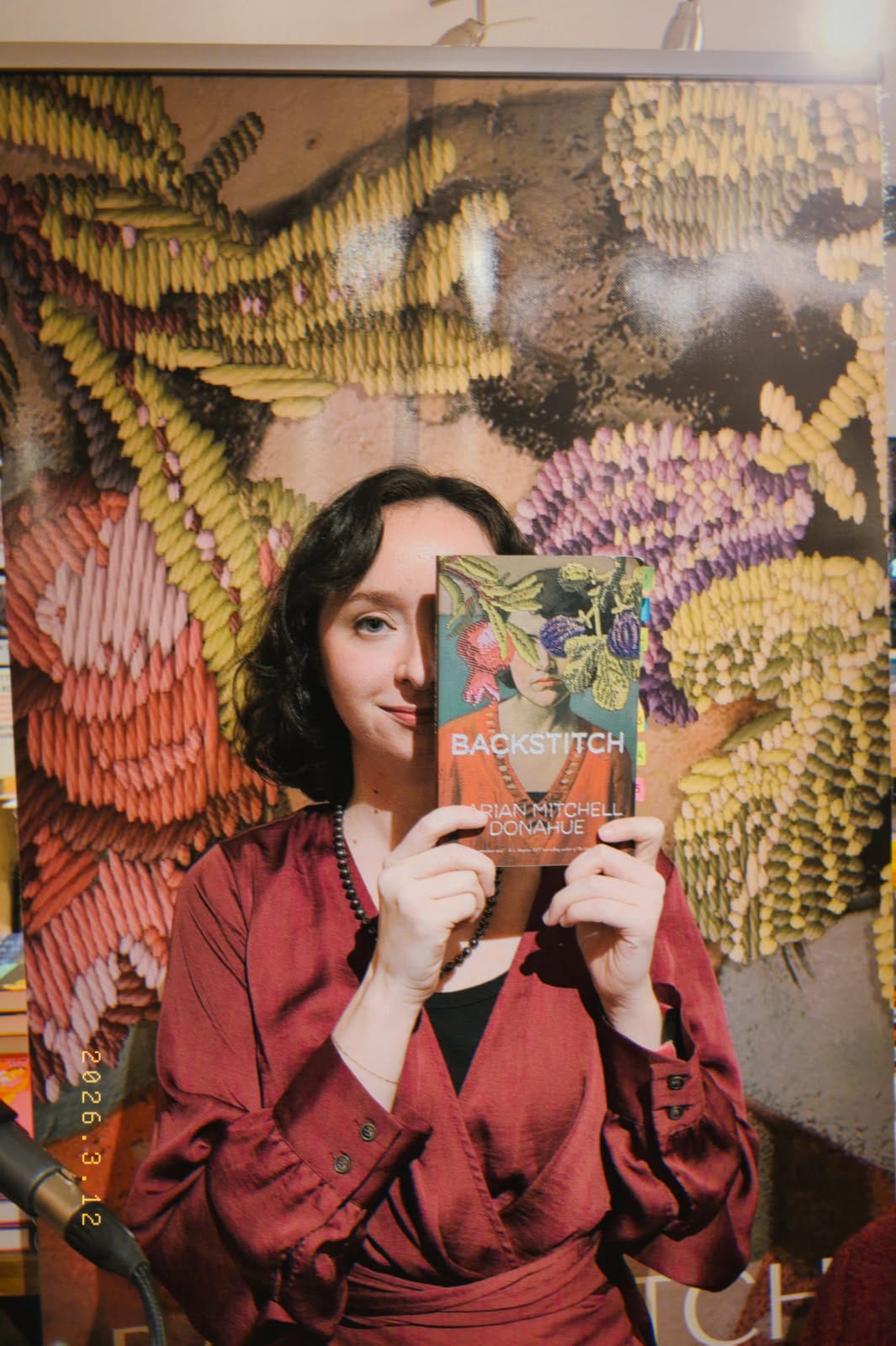
“The novel works like a puzzle, and Donahue handles this ambitious structure with deftness and confidence. […] The wideness of Donahue’s lens, which encompasses the perspectives of not only the artist-parent but also her daughter-subjects, is illuminating but not exhaustive; like any retrospective show, the novel suggests the full picture of Alice’s identities and contradictions through representative moments. In that, it feels true. […] a fascinating and rewarding novel.” – The New York Times
“Backstitch is a splendid, irreducible work of art – about making art, about time, about memory, about the stars in the heavens, and maybe most of all about family.” – Paul Harding, Pulitzer Prize-winning author of TINKERS
Do you want to win this book?
To sign up for the giveaway, you can fill out this form. Your name will be thrown into the hat for a shot at a paperback copy. This giveaway closes at midnight ET on Wednesday, 04/22/26. Winners will be notified within 48 hours of the giveaway closing and announced in a future newsletter/post.
Important to Note: You must be 18+ and a United States resident (pesky international laws make it tricky to do giveaways worldwide). If you are someone who loves to read the rules, you can find the obligatory info here.
What’s Bringing Me Joy
A little slice of La Dolce Vita….such a gorgeous film. Fellini was such a genius.
This is the wildest kind of art project!
Thomas Dolby has been so influential behind the scenes of music for decades and few people really know about it.
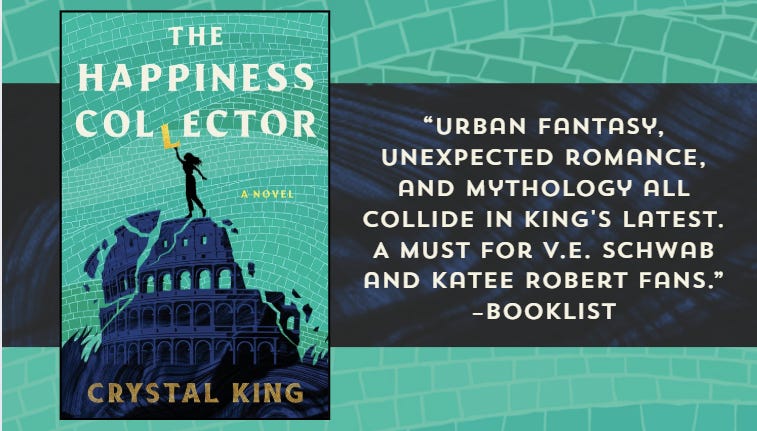
If you love food and love Italy, and haven’t read IN THE GARDEN OF MONSTERS, THE CHEF’S SECRET, or FEAST OF SORROW, click the links to learn where to buy your copy! And now you can order my latest, THE HAPPINESS COLLECTOR!
Follow me here: Website | Instagram | Facebook | Threads | Bluesky | TikTok